
Basketball Court Flooring Indonesia: FIBA Specs & Price
Choosing basketball court flooring is a structural decision, not a finishing touch. The floor decides how the ball behaves, how much load a player’s knee absorbs on landing, how often a shoe grips or slips, and how many years pass before you pay for a full refurbishment. This guide is written for international schools, foreign contractors, architects and sport hall operators who build or renovate courts in Indonesia and across Southeast Asia. Every figure here comes from our own supply and installation work out of Surabaya, and every price is quoted in Indonesian Rupiah per square metre so you can compare systems on equal terms.
What basketball court flooring actually has to do
A court floor has four jobs at once, and they pull against each other. It has to return the ball predictably, absorb impact so players are not injured, give controlled grip so a pivot is safe but a slide is not violent, and survive years of shoes, spectator seating, volleyball nets and cleaning machines. A floor that is very hard returns the ball beautifully and destroys knees. A floor that is very soft protects joints and kills the dribble. The whole engineering exercise is finding the middle.
This is why international federations publish numbers instead of adjectives. When a specification says a floor is “professional grade”, that claim is unverifiable. When it says ball rebound is 94 percent and shock absorption is 56 percent, it can be measured on site and either passes or fails. Ask for numbers in every quotation you receive.
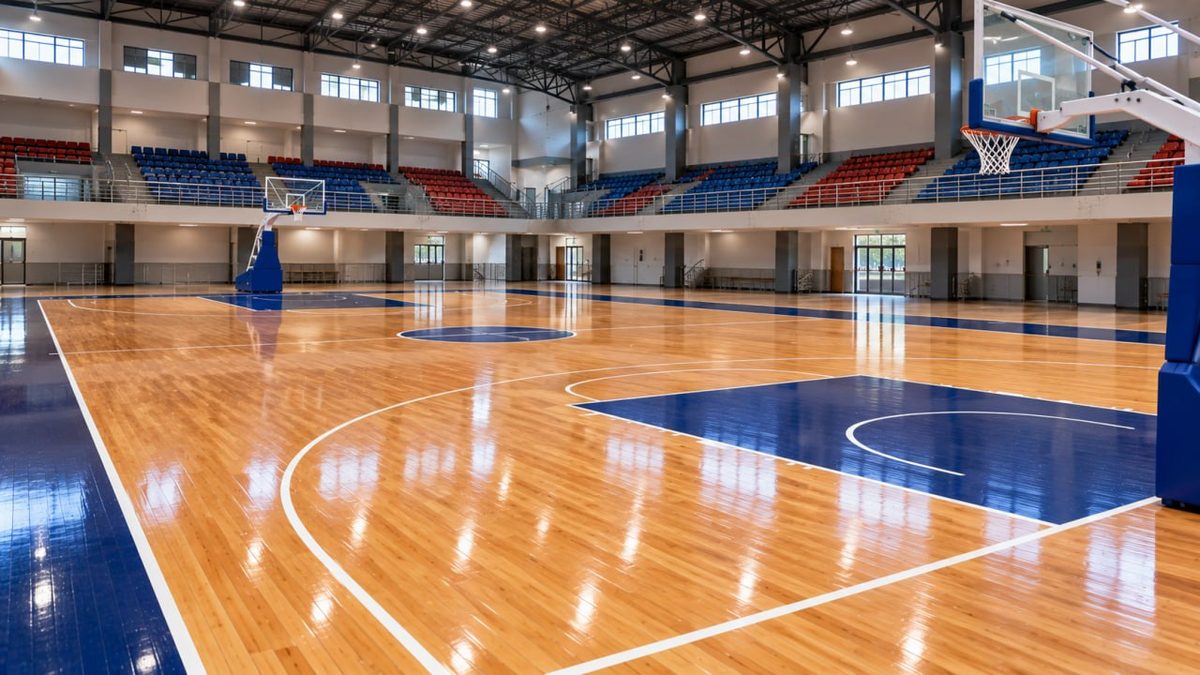
FIBA performance parameters and why each one matters to an owner
The parameters below are the FIBA Level 1 reference values we build to. Each one is followed by what it means in money and risk terms, because that is usually the part specifications leave out.
Ball rebound: 90 to 98 percent
A ball dropped from 1.8 metres onto the court must bounce back to between 90 and 98 percent of the height it would reach on solid concrete. Below 90 percent the floor is eating energy, the dribble feels dead, and players compensate by bouncing harder. Owners feel this as complaints from coaches and, in tournament venues, as a refused sanction. Rebound is mostly a function of panel stiffness and how the cradle or sleeper system is spaced. It cannot be fixed later with coating.
Vertical deflection: minimum 2.3 mm
Under a standard impact the surface must flex at least 2.3 mm. Deflection is the floor doing the work instead of the player’s joints. A rigid floor glued directly onto concrete will typically fail this, which is the single most common defect we are called in to correct. Correcting it means lifting the finished surface and rebuilding the substructure, so the cost of getting deflection wrong is close to the cost of the whole floor.
Coefficient of friction: 0.4 to 0.6
Grip has a safe window. Under 0.4 the surface is slippery and ankle injuries rise. Over 0.6 the shoe sticks, the foot stops before the body does, and knee injuries rise. Friction is controlled by the finishing system, not the timber species, and it drifts over time as the coating wears and as dust accumulates. This is why a cleaning protocol is a safety document, not housekeeping.
Shock absorption: minimum 53 percent
The floor must absorb at least 53 percent of impact force rather than returning it to the body. For a school that runs physical education classes six hours a day this is the parameter with the largest long term liability attached. It is delivered by elastic pads in the substructure, and it is the first thing lost when a budget is cut by removing the cradle layer.
Flatness and moisture
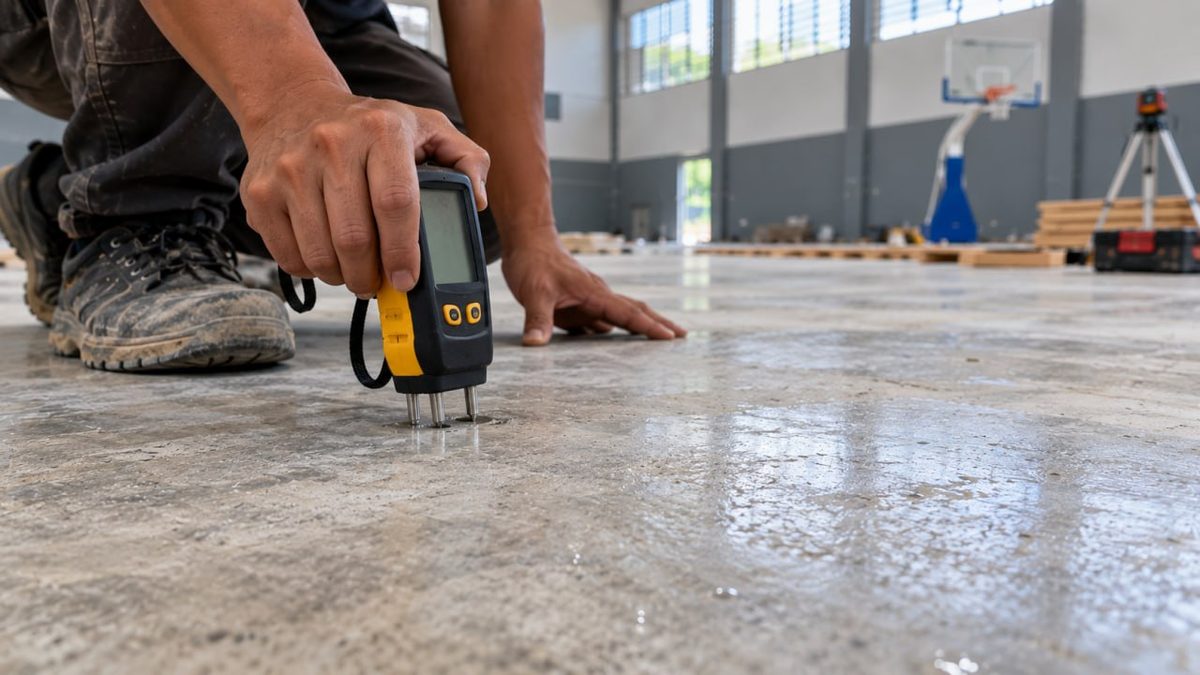
Two site conditions sit underneath all four numbers. Surface flatness should be within roughly 2 mm over a 2 metre straightedge, and the concrete slab must be dry before anything is laid. In Indonesian humidity a slab that reads high on a moisture meter will push water into the system for months and cup the boards. We measure and record this before installation and recommend you keep the reading as part of your handover file.
Basketball court flooring systems compared by price and performance
The table below covers the systems we actually supply and install. Prices are total installed cost per square metre in Indonesian Rupiah, covering material, substructure, labour, finishing and line marking for a standard court. Two rows are marked as indicative because they depend heavily on brand and specification: treat those as a range and confirm with our team before you budget.
| System | Installed price per m2 (IDR) | FIBA Level 1 achievable | Typical use | Service life before major refurbishment |
|---|---|---|---|---|
| Solid maple | 900,000 to 1,400,000 | Yes | Tournament and university sport halls | 25 years or more with recoating |
| Solid jati (teak) | 750,000 to 1,050,000 | Yes | Premium school and club courts | 25 years or more with recoating |
| Solid merbau | 600,000 to 800,000 | Yes | School and community indoor courts | 20 years or more with recoating |
| Engineered sport timber | Indicative range, confirm with our team | Yes, system dependent | Humid sites and fast build programmes | 15 to 20 years |
| Sport vinyl | 275,000 to 425,000 | Partially, depends on backing | Multi purpose halls, budget conscious schools | 10 to 15 years, replace not recoat |
| Polypropylene interlock | 150,000 to 250,000 | No | Outdoor and semi outdoor recreational courts | 8 to 12 years |
| Acrylic outdoor coating | Indicative range, confirm with our team | No | Outdoor concrete courts | 4 to 6 years per repaint cycle |
Read the table from the right hand column backwards. A maple court at the top of the range costs roughly six times a polypropylene court per square metre, but it lasts two to three times as long and can be sanded back to new several times. A polypropylene court is replaced outright. For a building you intend to keep for thirty years, the cheap system is bought several times over.
If you are also specifying timber for lobbies, offices or seating decks around the hall, our wood flooring price list per square metre covers the non sport grades, and solid teak tongue and groove is the species most often matched to a teak court.
Subfloor and cradle systems: the layer that decides compliance
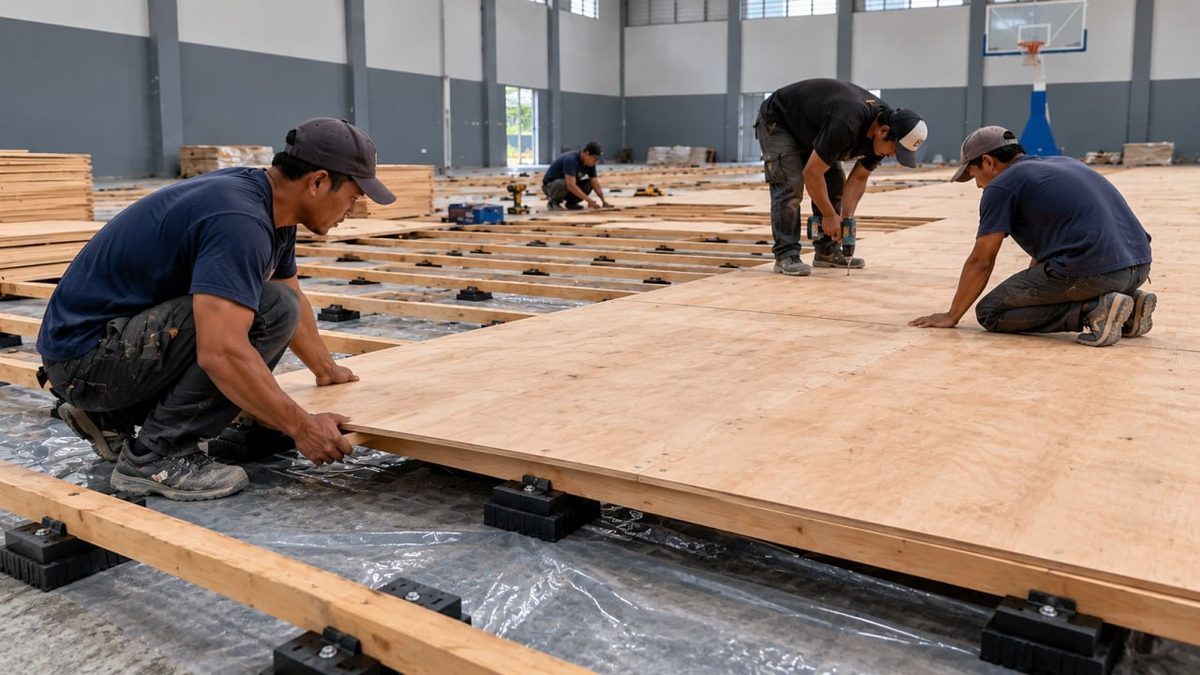
Everything a player feels is produced below the visible surface. A compliant sprung system is built in layers, from the slab upward: a vapour barrier over the concrete, elastic pads, timber sleepers or a battened cradle, a plywood deck in one or two layers, then the wear surface.
The pads supply shock absorption. The sleeper spacing and plywood thickness together tune deflection and rebound. Change the pad hardness and you move shock absorption. Change the sleeper spacing and you move both deflection and ball rebound at once, which is why substitution without retesting is not a neutral decision.
Three system families are worth knowing by name. A cradle system, where sleepers sit in clips on pads, gives the most even deflection and the highest compliance ceiling. A single or double sleeper system on discrete pads is the common school specification and reaches Level 1 when correctly designed. A portable system uses prefabricated panels on integrated pads, is laid and lifted for events, and is the right answer for a multi function arena.
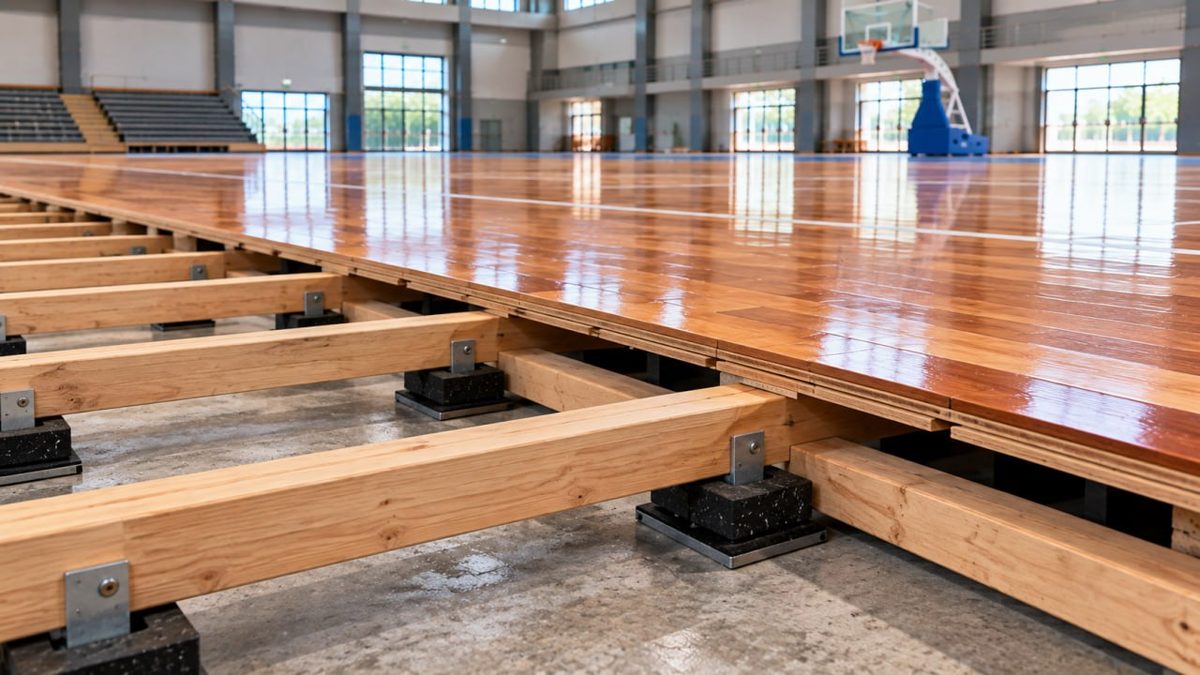
One practical note on ventilation. A sprung system contains an air cavity. That cavity has to breathe at the perimeter, so the skirting detail includes vents. Sealing the perimeter tight, which looks neater, traps humidity under the floor and causes cupping within one wet season.
Court dimensions, run off zones and the area you must actually budget
The FIBA playing court is 28 by 15 metres measured to the inside edge of the boundary lines, which is 420 square metres. That number alone underestimates your floor order, because you need clear run off around the court and because most halls are floored wall to wall.
| Configuration | Playing area | Recommended run off | Approximate floored area |
|---|---|---|---|
| FIBA full court | 28 x 15 m (420 m2) | 2 m all round | 32 x 19 m, about 608 m2 |
| School or community full court | 26 x 14 m (364 m2) | 1 to 2 m all round | About 448 to 540 m2 |
| FIBA 3×3 court | 15 x 11 m (165 m2) | 1 to 2 m all round | 19 x 15 m, about 285 m2 |
| Practice half court | 15 x 15 m (225 m2) | 1 to 2 m | About 285 to 323 m2 |
Ceiling height matters as much as plan area. Plan for at least 7 metres clear above the playing surface for competition use and treat anything under 6 metres as recreational only. If you are sizing a smaller facility, our dedicated page on basketball court flooring types, standards and pricing sets out the half court and 3×3 variants in more detail.
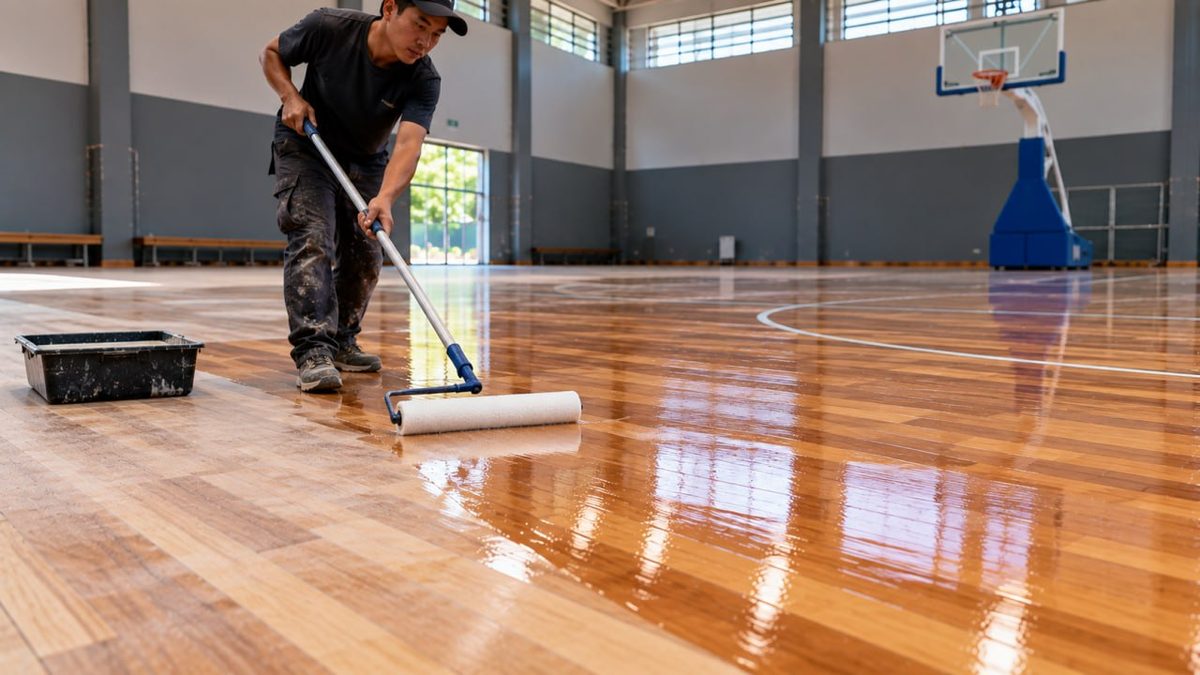
Installation stages and realistic duration
The durations below are for a single FIBA sized court with normal site access and no structural repair to the slab. Multi court halls do not scale linearly, because curing and coating stages overlap between courts.
| Stage | What happens | Duration | Owner action required |
|---|---|---|---|
| 1. Survey and moisture test | Slab flatness, moisture reading, level datum, access check | 1 day | Provide drawings and slab age |
| 2. Material acclimatisation | Timber conditioned in the closed hall to local humidity | 7 to 14 days | Hall must be weather tight and lockable |
| 3. Slab preparation | Grinding, levelling compound where needed, vapour barrier | 2 to 4 days | Approve any remedial work |
| 4. Substructure | Pads, sleepers or cradle, alignment and levelling | 4 to 7 days | Hold point inspection |
| 5. Plywood deck | One or two layers, staggered and fixed | 2 to 4 days | None |
| 6. Wear surface | Boards laid, nailed and closed up | 5 to 8 days | None |
| 7. Sanding | Coarse to fine passes to a flat, clean surface | 2 to 3 days | Keep the hall closed to other trades |
| 8. Sealer and line marking | Sealer, court lines and logos set out and painted | 3 to 5 days | Approve line colours and logo artwork |
| 9. Top coats and cure | Two or more finish coats, then curing | 5 to 10 days | No traffic at all during cure |
| 10. Testing and handover | Rebound, deflection, friction checks, documentation | 1 to 2 days | Witness testing, receive care manual |
Total programme for one court is typically five to seven weeks from mobilisation. The two stages clients most often try to compress are acclimatisation and final cure, and those are precisely the two that cannot be compressed without consequences. Skipping acclimatisation produces gaps or cupping. Walking on an uncured coating leaves permanent marks and reduces abrasion resistance.
Indoor versus outdoor basketball court flooring
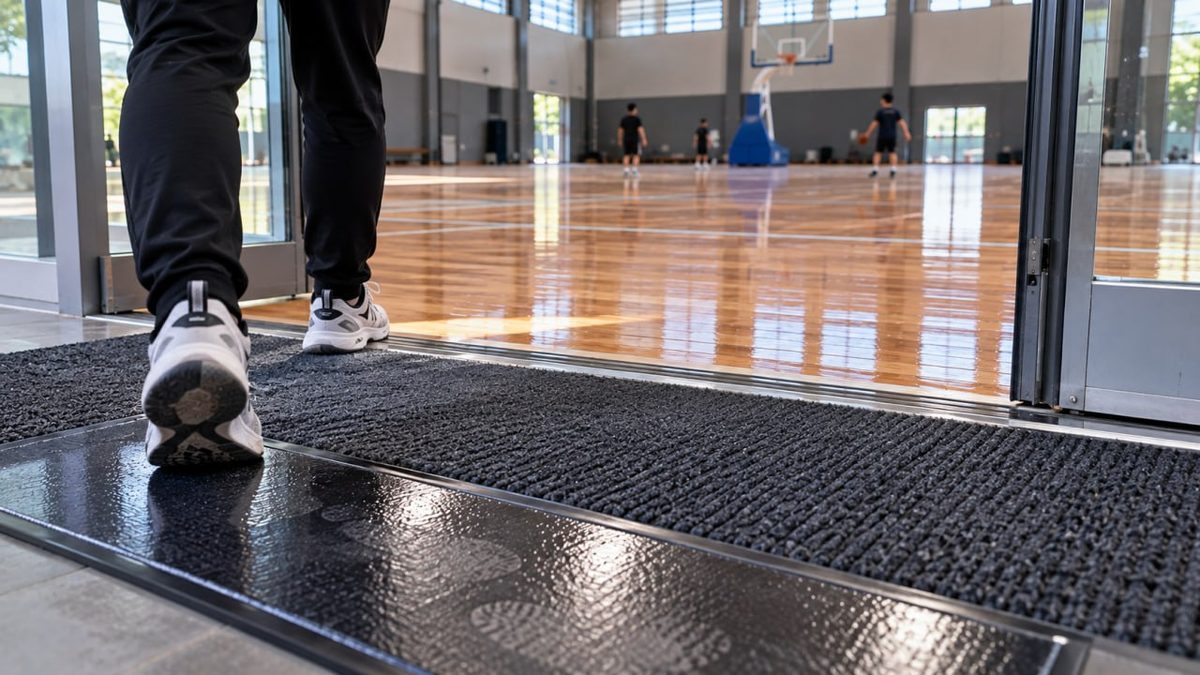
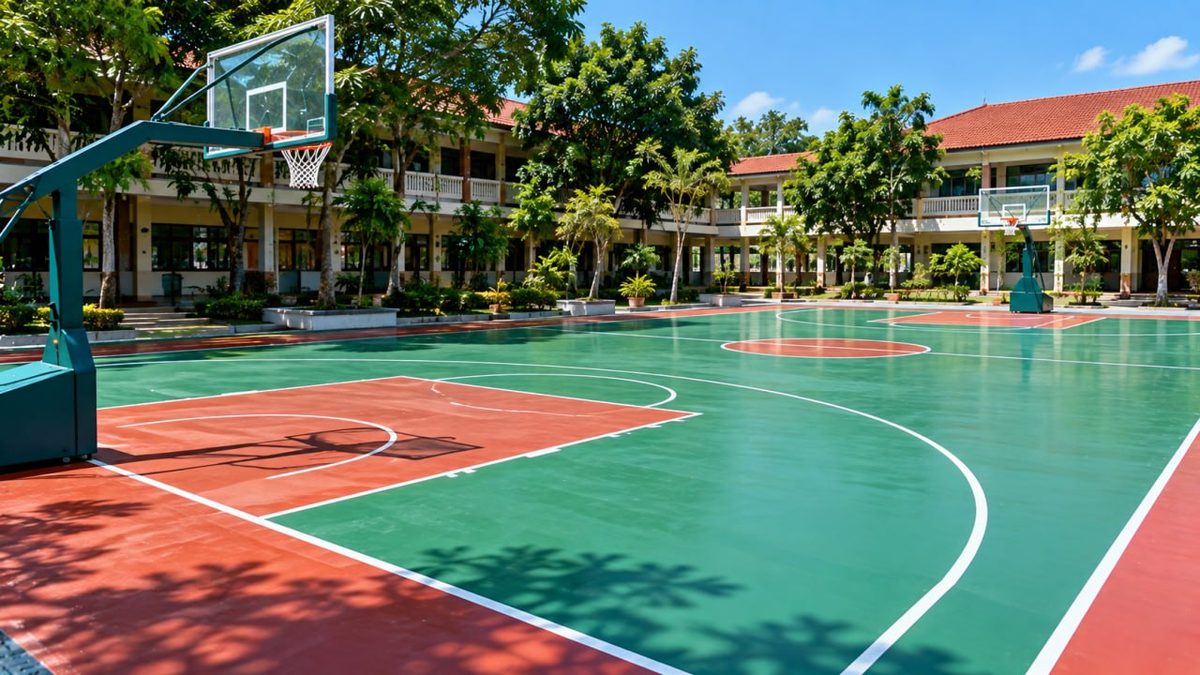
Timber does not belong outdoors in a tropical climate. Rain, direct sun and daily humidity swings will destroy a hardwood sport floor regardless of the coating, and no warranty we or anyone else offers will cover it. For open air courts the realistic options are polypropylene interlocking tiles or an acrylic coating system over a properly finished concrete slab.
Polypropylene tiles drain, tolerate heat, and can be lifted and relaid. They give less shock absorption than a sprung timber floor and will not meet FIBA Level 1, which is acceptable for recreational and training use. Acrylic systems are the cheapest per square metre and the most maintenance hungry, with a repaint cycle every four to six years in Indonesian sun.
Semi outdoor courts, meaning roofed but open sided, are the awkward middle case. Driven rain and high humidity still reach the surface. We treat these as outdoor unless the sides can be closed. If your project involves external timber decking around a semi outdoor facility, that is a different material specification entirely and our outdoor wood decking guide covers the suitable species.
Line marking and colour decisions
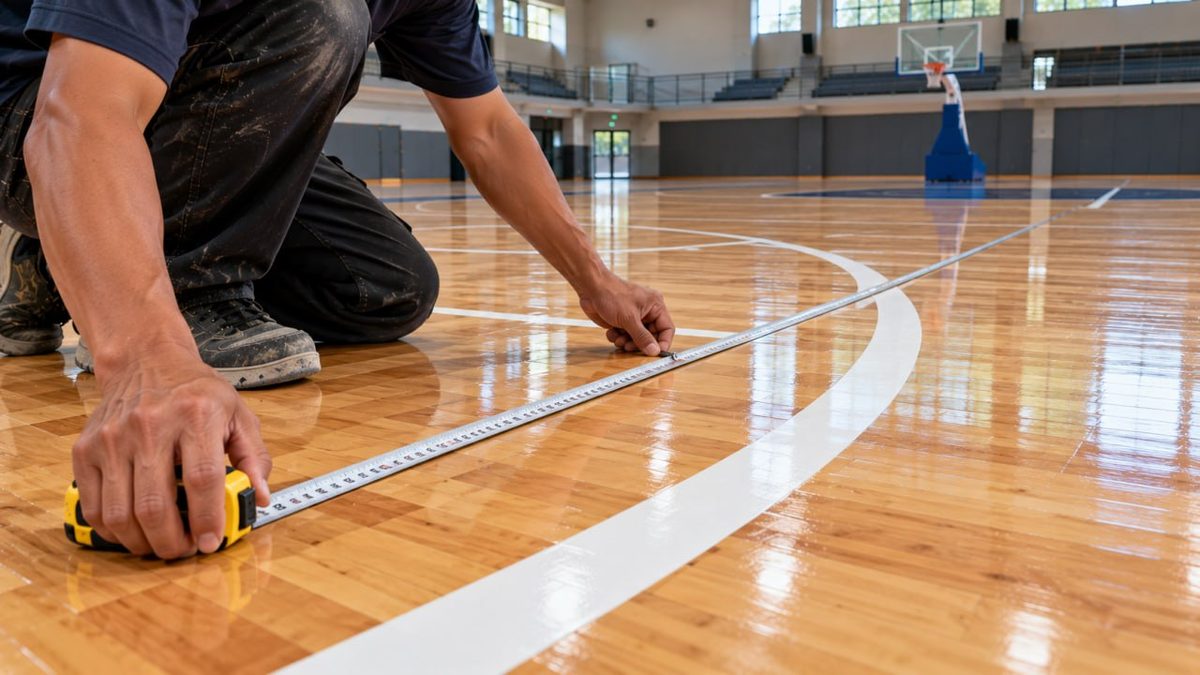
Lines are painted after sealing and before the final coats, so they are protected by the top layer. FIBA competition lines are 5 cm wide and must be a single colour that contrasts clearly with the surface. On natural timber, white is the safe default and the most widely accepted for sanctioned play.
Problems arise in multi sport halls, where basketball, volleyball, badminton and futsal lines share one floor. Four sets of lines in similar tones produce visual confusion and slow players down. The workable approach is one dominant colour for basketball and clearly differentiated, lower contrast colours for the secondary sports, sometimes with a tinted key area to separate the basketball zone visually. We set this out on site with tape for client approval before any paint is applied, and our guide to recommended court line colours on parquet shows the combinations that stay readable.
Maintenance, screening and recoating
A hardwood court is a long life asset only if it is maintained on schedule. The routine is simple and non negotiable: dry dust mop daily with a microfibre head, damp clean weekly with a neutral pH cleaner designed for sport floors, and never flood the surface with water. Water sitting in a board joint for a day is enough to swell it.
Beyond routine cleaning there are two interventions. Screening and recoating, which means abrading the existing finish and applying fresh coats, restores friction and gloss and is typically needed every three to five years depending on hours of use. Full sanding back to bare timber and refinishing is a major operation that a solid hardwood floor can take several times across its life, usually at intervals of ten years or more or when damage is deep.
Three rules protect the investment between those cycles. Require non marking soles for all users, including spectators at events. Use protective covering whenever the hall is used for assemblies, exhibitions or seating. Keep the hall humidity reasonably stable, because most timber floor failures we attend are moisture events rather than wear.
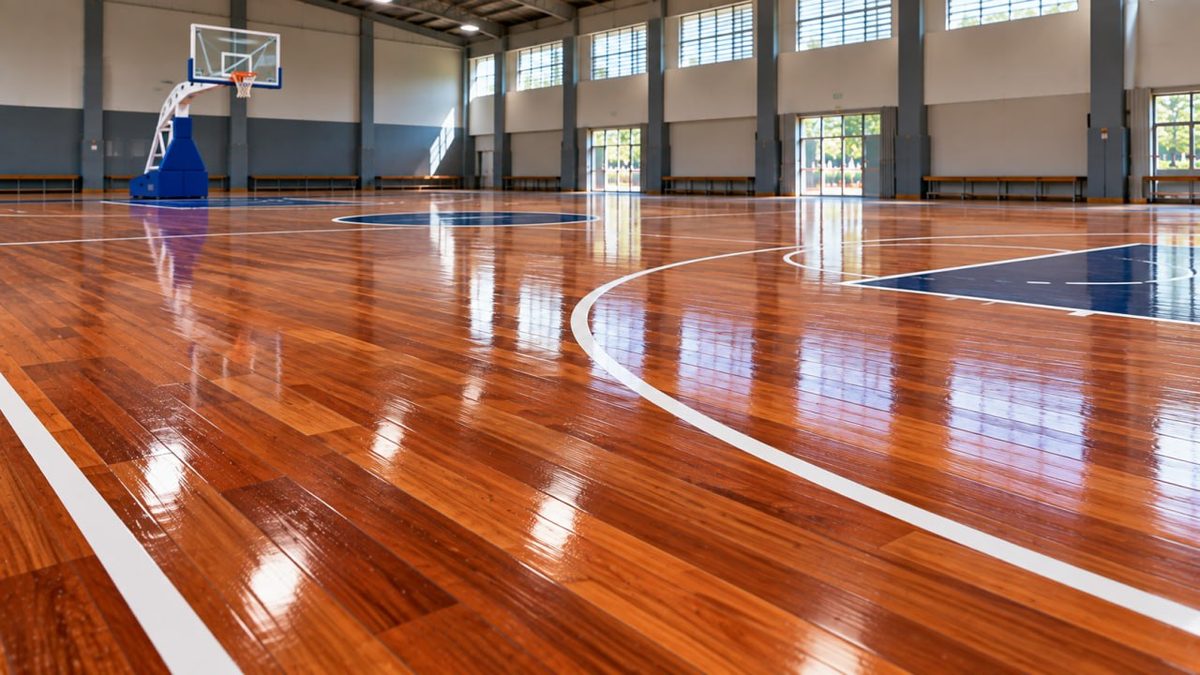
How to evaluate a basketball court flooring contractor
The market contains general flooring installers who take sport court work occasionally. The difference shows up two years after handover. These are the questions that separate the two, and the answers you should expect.
- Which performance values will you guarantee in writing, and how will they be measured at handover? A specialist names ball rebound, deflection, friction and shock absorption. A generalist talks about material brands.
- Show me the substructure build up drawing for my slab. If there is no section drawing, there is no engineered system.
- What moisture reading will you accept before laying, and what happens if the slab fails? The correct answer is a defined limit and a written remedial step, not a promise to proceed anyway.
- How long is acclimatisation on my site? Anything under a week in a coastal Indonesian city is a warning sign.
- What is excluded from the price? Slab levelling, hoops, seating protection and logo artwork are the usual exclusions that surface later as variations.
- What does the warranty actually cover, and for how long? Separate the timber, the coating and the workmanship, because they are rarely the same period.
- Who performs maintenance and recoating, and at what rate? A contractor who cannot quote a recoat has not planned for the floor’s life.
- Can I see a court you built at least three years ago? New work looks good regardless of quality. Three year old work does not.
Our own sport court capability, scope and pricing are set out on the basketball court contractor page, and general installation terms are on our parquet installation service page.
Our basketball court portfolio
We keep this section short and verifiable rather than long and vague. Two projects are relevant to buyers evaluating us for court work.
UB Sport Center Malang. A portable basketball court system built to FIBA Level 1 performance. Portable means the panels are laid for events and lifted afterwards, so the hall serves other functions without compromising the court specification when basketball is played. This project is the reference we point to when a client needs Level 1 performance in a building that cannot be dedicated to one sport.
SIS Surabaya, Surabaya Intercultural School. An international school installation. School courts carry a different load profile from competition venues: continuous daytime use by students of widely different weights and skill levels, which puts the emphasis on shock absorption and on maintenance that non specialist staff can actually perform.
We do not publish project counts or client lists we cannot substantiate. If you need a reference visit to either site, ask and we will arrange it subject to the operator’s permission.
Service coverage in Indonesia and export inquiries
We are based in Surabaya, East Java, and supply and install across Indonesia. East Java projects are handled directly by our own crews. For Jakarta, Bali, Kalimantan, Sulawesi and other regions we mobilise a supervised installation team with materials shipped from Surabaya, and the programme in the duration table above extends by mobilisation and shipping time.
For buyers outside Indonesia, we quote material supply for hardwood sport flooring and can discuss supervised installation depending on project size and destination. Indonesian merbau and teak are competitive against imported maple on both price and hardness, which is the usual reason a Southeast Asian project asks us for a comparison. Send the court drawing, the destination port and your target performance level and we will respond with a scope and a price.
The fastest route to a quotation is WhatsApp. Message us at wa.me/6285174200066 with your hall dimensions, slab condition and intended use, in English is fine. You can also browse our Surabaya wood flooring range or start from our home page.
Frequently asked questions about basketball court flooring
What does a FIBA compliant wooden basketball court cost in Indonesia?
For a full court of about 608 square metres including run off, a merbau system at 600,000 to 800,000 Rupiah per square metre works out to roughly 365 to 486 million Rupiah installed. Teak at 750,000 to 1,050,000 gives about 456 to 638 million, and maple at 900,000 to 1,400,000 gives about 547 to 851 million. Hoops, seating and building works are separate.
Can a basketball floor be laid directly on concrete?
Not if you need FIBA Level 1. Direct glue down cannot reach the minimum 2.3 mm vertical deflection or 53 percent shock absorption, because there is no elastic layer to provide them. Direct application is only appropriate for vinyl or acrylic systems on recreational courts.
Is Indonesian merbau or teak a real alternative to imported maple?
Yes, for most projects. Both species are hard enough and stable enough for sport use when properly dried and installed on a compliant substructure, and both are cheaper delivered in Indonesia than imported maple. Maple retains an advantage in colour uniformity and in the expectations of some tournament organisers.
How long until we can play on a new court?
Plan five to seven weeks from mobilisation for one court, then allow the full curing period on the final coats before any traffic. The exact cure window depends on the coating system and site humidity and will be stated in your handover documents.
How often does a court need recoating?
Screening and recoating every three to five years for a typical school or club court, sooner for venues in heavy daily use. Full sanding back to bare timber is needed far less often, generally after a decade or more or when there is deep damage.
What is the minimum ceiling height for a competition court?
Allow at least 7 metres clear above the playing surface for competition use. Between 6 and 7 metres is usable for training and school play. Under 6 metres should be treated as recreational.
Do you supply and install outside East Java and outside Indonesia?
Yes. We install nationwide with materials shipped from Surabaya and a supervised crew. For projects outside Indonesia we quote material supply, and installation supervision is discussed case by case based on project size and destination.
Can one floor carry basketball, volleyball and badminton lines?
It can, and most school halls do. The constraint is visual clarity rather than technical. Make basketball the dominant line colour, keep secondary sports in lower contrast tones, and approve the layout from a taped mock up on site before painting begins.

Tuliskan Komentar